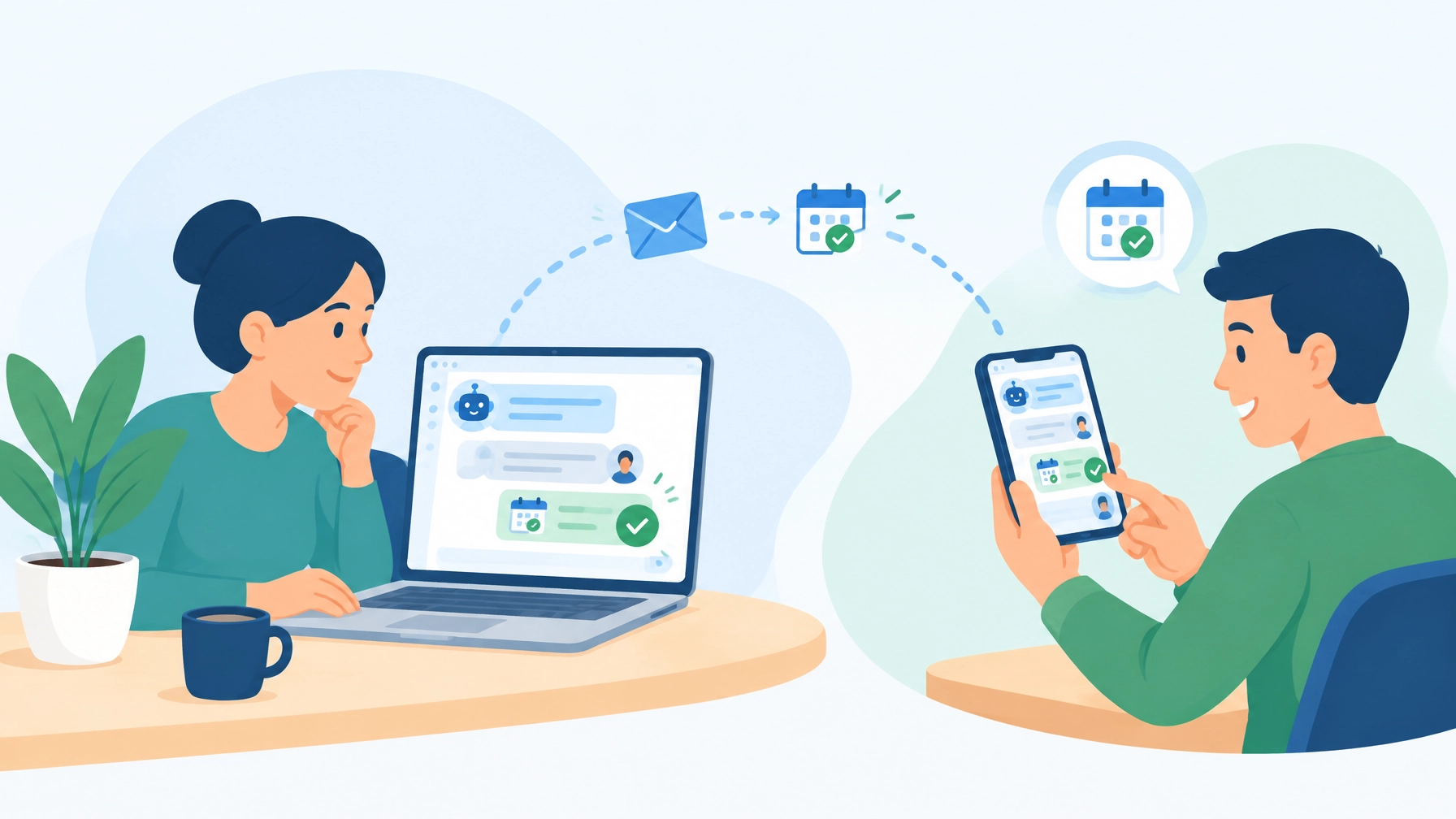
Live chat advice tends toward the abstract: be responsive, be human, qualify gently. Useful, and useless at 2:14 on a Tuesday afternoon when a chat notification appears and someone's actual words are waiting. What follows is a complete chat conversation, annotated, showing what a good one looks like from the first hello to the booked appointment.
This article breaks down a conversation handled in LiveChat, the platform we use as the example. It complements our coverage planning guide, which decides who answers; this article shows what a good answer looks like. The business is an illustrative salon, and the visitor arrived on the booking page.
The conversation, annotated
Visitor: Hi, do you have any openings this week?
The visitor's first message contains more information than it appears to: they are ready to buy, this week, and they checked availability before asking a human. The responder's job is to convert readiness into a booking without adding friction.
Staff: Hi! Yes, we do. Which service are you booking?
Three words of acknowledgment, then the qualifying question. The error this avoids is the essay reply, the full greeting with hours, location, and service list, which makes a ready buyer read a brochure. A ready buyer gets a fast, direct path.
Visitor: A cut and color. Thursday if possible.
Staff: We have Thursday at 2 with Maria or 4:30 with Jordan. Does either work?
The response converts the visitor's readiness into a choice between two concrete options, which is the canned-response discipline at its best: the specific answer requires the responder to know the calendar, and the choice format moves the conversation one step from booked. A question that could be answered by a calendar link was answered by a human with the calendar open.
Visitor: 4:30 with Jordan. How much will that be?
Staff: Cut and color with Jordan runs $140 to $180 depending on length. I can hold the 4:30 for 15 minutes while you book, here's the link.
The price answer is honest and ranges, because a range is the truthful answer, and the booking link arrives with a held slot, which converts the conversation's momentum into a reservation before it decays. The 15-minute hold is the critical move: it gives the visitor a small, honest deadline that protects the business's calendar from abandoned holds.
Visitor: Booked, thanks!
Staff: You're all set. You'll get a confirmation text. See you Thursday.
The close confirms what happens next, names the confirmation channel, and ends warmly in one line. Total conversation: about three minutes, seven messages, one booking.
What made it work
Three properties separate this conversation from the chats that fizzle.
Speed at the start. The first reply arrived within a minute, which is the coverage window working as designed. A ready buyer's second-best option is a competitor's chat window, and response latency is where chat conversions are won or lost before any technique applies.
Every reply moved the conversation forward. No message in the exchange was filler. Each staff reply either answered the exact question asked or advanced toward the booking, which is the same give-new-information discipline as a good outreach sequence. The chat that repeats, restates, and hedges trains the visitor to drift.
The human handled judgment; the software handled plumbing. The responder knew the calendar, the stylists, and the price range, and used that judgment to present two real options. The platform carried the notification, the canned snippets, and the booking link. This is the division of labor principle in chat form: the system delivers the conversation, and the human makes it worth having.
The failure modes, for contrast
The same conversation goes wrong in three common ways.
The brochure reply: "Hi! Welcome to [Salon]. We're located at... our hours are... our services include..." A ready buyer asked a specific question and received a homepage. The fix is answering the question first, always.
The interrogation: a four-question qualification form before offering a single time slot. Ready buyers tolerate one qualifying question; the second one loses the small-talk-purchase trade that chat exists to offer.
The calendar shrug: "You can check availability on our booking page." The visitor was on the booking page, and the chat's entire value over that page is a human who can look at the calendar and help. If the responder cannot see availability, the coverage plan needs to fix the tooling, because the chat is being answered by a person doing an FAQ's job.
Questions to answer before your next chat
Before the next notification, write down: What is our first-reply target, in seconds, and is the coverage window staffed to hit it? What is the one qualifying question that matters most for our bookings? Who answers with the calendar open? What is our hold policy for pending bookings? What does our close confirm, and in how many lines?
Five answers, and the chat team is running a playbook rather than improvising. MBH Web Services sets up chat systems with exactly this conversation design, including the canned-response library that makes fast replies personal rather than robotic, but the annotated exchange above is a complete template for a small team: answer the question, offer two real options, hold the slot, confirm the next step. Train the team on the pattern, and let LiveChat deliver the visitors who are already ready to book.