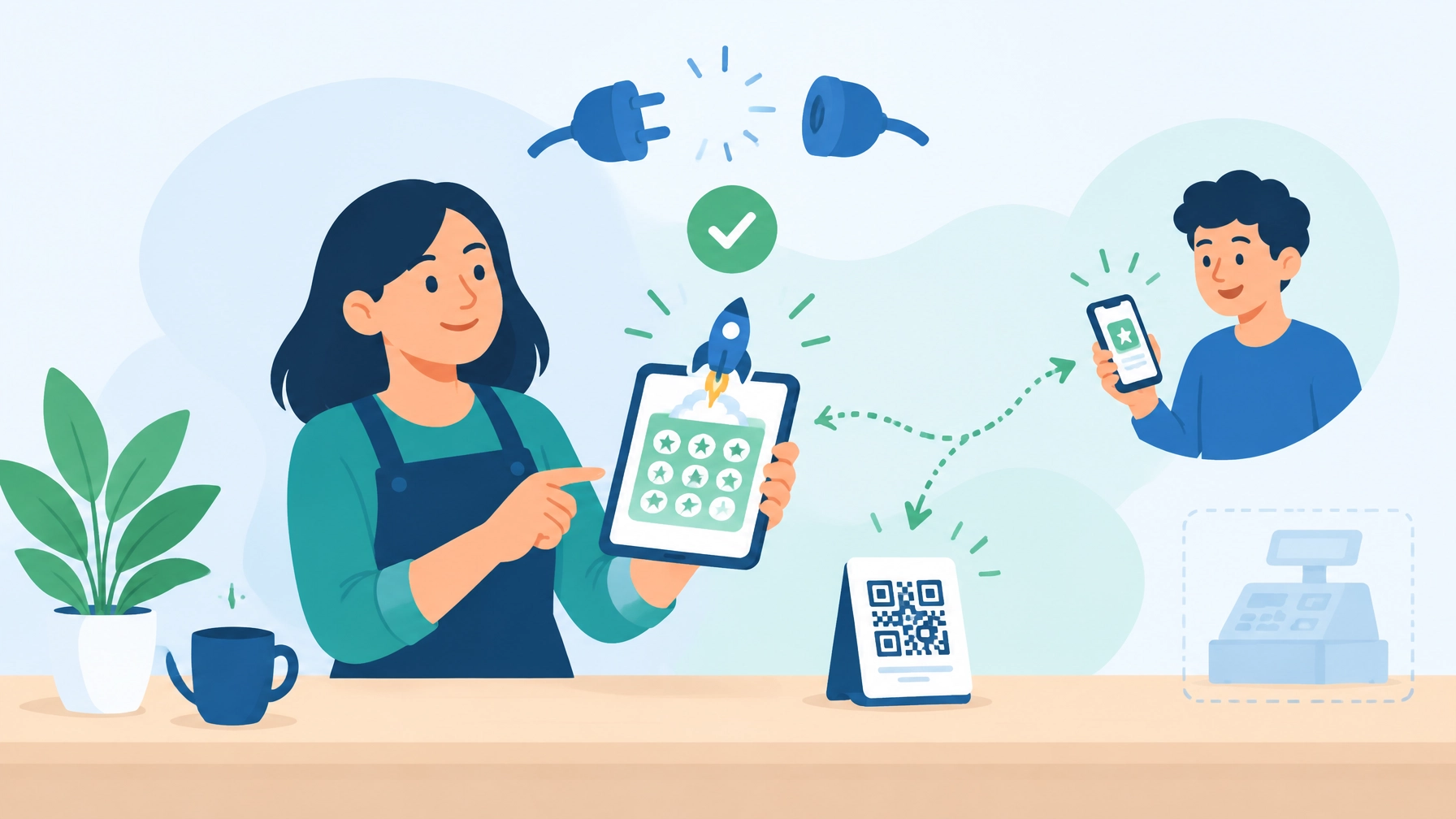
Loyalty programs are usually described from the owner's side: configuration, rules, redemption settings. Customers experience none of that. They experience a journey: a moment at the counter, a card appearing on their phone, stamps accumulating over visits, and eventually a free item. Whether the program works is decided almost entirely by how that journey feels, because a program customers abandon mid-card is a program that costs money and earns nothing.
This article walks the customer's side of a BoomerangMe digital stamp card, step by step. It pairs with our owner-side guide to designing a stamp card before you build it; that article covers the rules you write, and this one covers what customers actually experience as a result.
Moment one: the invitation
The journey begins with a sentence at the counter: "Would you like a digital stamp card for this? It lives in your phone's wallet." That invitation carries more weight than it seems, because it has to answer three customer questions in a few seconds: what is this, how much work is it, and what do I get.
The owner-side design work behind that sentence is choosing a reward customers actually want and a threshold they can actually reach. A customer invited to a program whose tenth-visit reward feels distant will decline politely and never think about it again. The invitation only works if the reward is close enough to feel real.
The critical property of the digital card reveals itself in this moment: the customer does not need to install an app or carry a physical card. Customers can enroll without a separate app by adding the card to their phone's wallet, which is what makes the counter invitation short enough to work during a transaction.
Moment two: enrollment
Enrollment should take under thirty seconds from the customer's side: scan a QR code or tap a link, see the card, add it to the wallet. Each additional step in that flow loses a share of customers, which is why the enrollment path deserves a test walk before launch, the same way we recommend testing any customer-facing tool path before customers meet it.
The customer's experience of a good enrollment: no account creation, no email address required unless the program wants it, and immediate visual confirmation that the card exists and has a stamp or is ready to earn one. The experience of a bad enrollment: a web form, a password, and a feeling of having signed up for something rather than joined something.
Moment three: earning stamps
This is where the program either becomes a habit or disappears from memory. The customer's experience of earning: at the register, the cashier applies the stamp, and the phone updates. The important property is visibility, and customers can check their progress, which is what push notifications can reinforce at the right moments.
The earning experience succeeds when it is frictionless for the staff member applying the stamp, because a slow stamp process during a rush pressures the staff to skip it, and skipped stamps teach customers the program is unreliable. The owner-side design work that protects this moment is the staff script and training, which we cover in our pre-purchase verification checklist.
Moment four: the abandoned middle
Most programs lose customers in the middle of the card, not at the start. The customer has three stamps, the reward is six visits away, and no reminder exists. This is the stretch where the program's design either carries the customer or doesn't, and it is where two features do their real work.
First, progress visibility: a card the customer can see progress on outperforms a punch card in a drawer, because the phone carries it. Second, well-timed communication: a notification when a card is halfway complete, or a modest bonus stamp after a period of absence, can revive a card that would otherwise die quietly. The design principle is that the middle of the card is the program's vulnerable period, and it deserves deliberate attention rather than being left to chance.
Moment five: redemption
Redemption is the moment the entire program exists for, and it is where trust is won or lost. The customer's experience of a good redemption: they mention the card, the cashier confirms the reward in one action, and the free item arrives without ceremony. The customer's experience of a bad one: the cashier is unsure how to apply it, a manager gets involved, and the reward the customer earned becomes an awkwardness both sides want to end.
The owner-side work that protects this moment is testing the full redemption path before launch, from both the staff and customer side, which is verification four in our six things to verify before you buy. A redemption that works in one action at the register, during a busy period, is the difference between a reward that reinforces loyalty and a reward that quietly ends it.
Moment six: the completed cycle
After redemption, the journey begins again, and the second cycle is where the program's economics actually live. A customer who completed one card and redeemed smoothly starts a second card with the habit already formed, which is why the cost model for a one-location program counts repeat cycles, not first enrollments, as the program's real engine.
The completed cycle also produces the program's most valuable marketing: a customer who mentions the free item to a friend is doing enrollment work the business would otherwise have to do at the counter.
The journey, condensed
- Invitation — The customer's experience: A short sentence at the counter; What protects it: Reward worth wanting, threshold within reach
- Enrollment — The customer's experience: Under thirty seconds, no app install; What protects it: Wallet-based enrollment
- Earning — The customer's experience: A quick stamp at the register; What protects it: Staff training and a fast application process
- The middle — The customer's experience: A card they remember exists; What protects it: Progress visibility and well-timed nudges
- Redemption — The customer's experience: A one-action reward, no ceremony; What protects it: Tested redemption path
- Second cycle — The customer's experience: A habit, not a decision; What protects it: Smooth first redemption
Six moments, and each one has an owner-side cause. The program customers experience is the sum of those causes.
Questions to answer before launch
Before the program goes live, walk it as a customer and write down: How long does the counter invitation take, and does it survive a busy transaction? How many steps is enrollment from a customer's phone? What happens at the register when a stamp is earned during a rush? What reminds a customer their card is half full? How many actions does a redemption take, and have I watched a real one? What starts the second card?
Six answers, and the program launches as a journey rather than a settings page. MBH Web Services implements loyalty programs with this customer-path-first framing, but the walk-through above is deliberately runnable by an owner with a phone and an afternoon. Walk the path as a customer first, then configure the BoomerangMe program to match it.