A customer asks a simple question at 8:30 p.m.: “Can I change my subscription, and will it affect my current users?” The answer may require account context, policy judgment, and a bit of reassurance. The technology you choose determines whether that customer gets a useful response, a handoff, or no response until morning.
That is the practical question behind LiveChat vs. ai chatbots: which does your business need? For small and mid-sized organizations, this is not just a choice between two website features. It affects staffing, service quality, system setup, employee workflows, and the ongoing work required to keep customer support dependable.
The right answer is often not one or the other. It depends on what your customers ask, when they ask it, and how much business context a response requires.
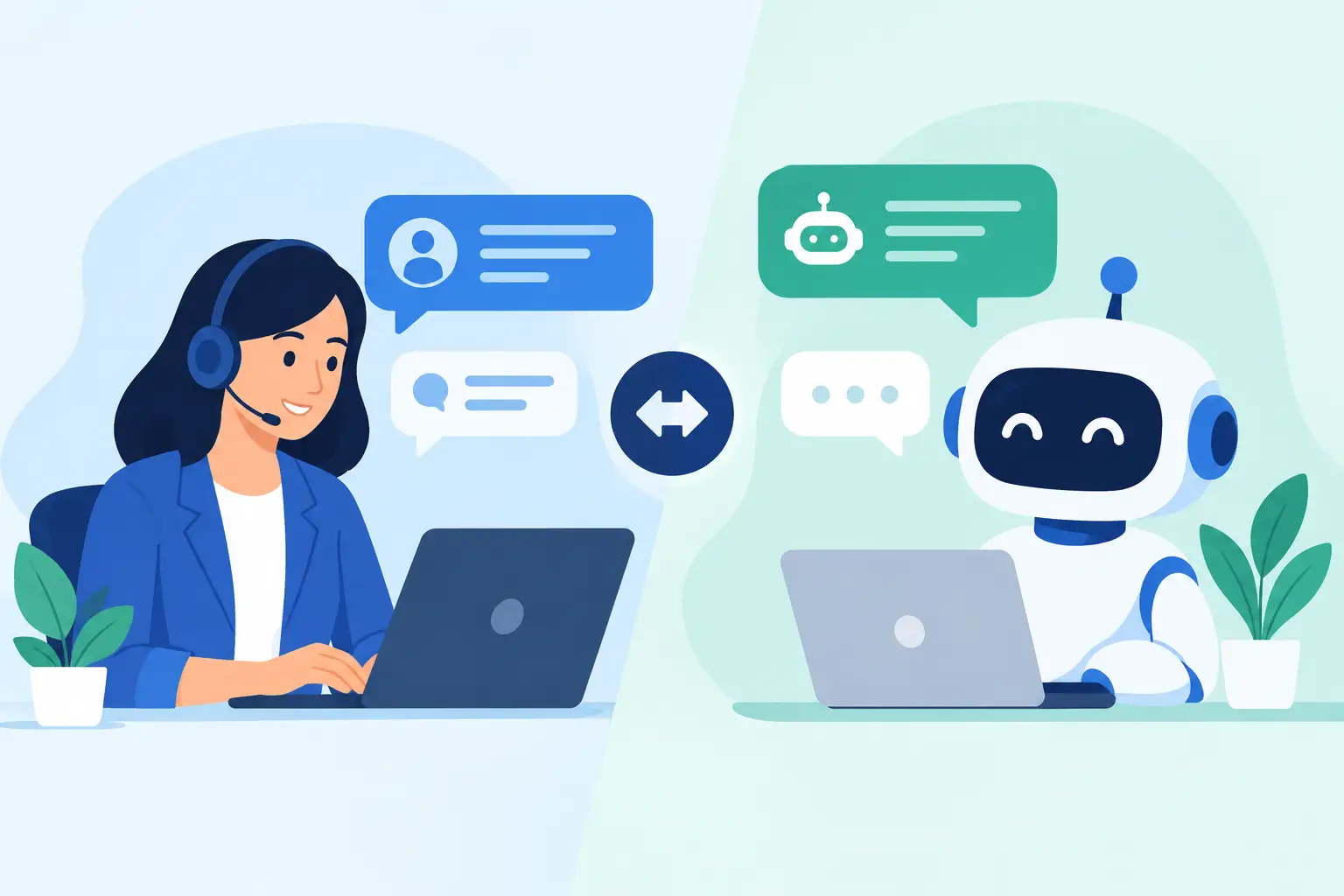
LiveChat vs. AI Chatbots: The Core Difference
Live chat connects a visitor or customer with a person in real time. That person can interpret an unusual request, read the tone of the conversation, review account details, and make a judgment call within your company’s policies. Live chat is especially valuable when the customer needs help completing a purchase, resolving a billing concern, troubleshooting a workflow, or deciding between service options.
AI chatbots use artificial intelligence to answer questions, guide visitors through common tasks, retrieve information from approved knowledge sources, and route conversations when human help is needed. They can provide immediate coverage outside business hours and reduce the number of repetitive questions that reach your team.
The difference is not simply human versus automated. It is predictable information versus situational judgment. A chatbot can be very effective when the answer is documented, current, and consistent. A person is more effective when the request involves exceptions, emotions, account-specific details, or consequences that require discretion.
For clarity, “LiveChat” can also refer to a specific software product. In this comparison, live chat means the broader practice of real-time human chat support, regardless of the platform used.
When Live Chat Is the Better Business Choice
Live chat is usually the stronger primary option when conversations directly influence revenue, retention, or customer trust. A prospect comparing plans may need more than a pricing-page answer. They may need help understanding how a service fits their team, existing software, and approval process. A capable representative can ask follow-up questions and move the conversation forward.
It also works well for businesses with complex offerings. Managed services, B2B software, professional services, healthcare administration, financial workflows, and other high-consideration purchases often create questions that do not fit neatly into a prewritten answer. Giving customers a quick path to a person can prevent confusion from becoming a lost opportunity.
Live chat has limits, however. Coverage requires people, training, schedules, clear escalation procedures, and access to accurate information. If agents lack the tools to see order status, account notes, or support history, chat can create a faster but still frustrating version of the customer service experience.
A live chat tool should therefore be implemented as part of an operating process. Decide who monitors it, what response-time commitment is realistic, which questions agents can resolve, and when they should transfer a case to billing, technical support, sales, or account management.
When an AI Chatbot Makes More Sense
An AI chatbot is well suited to high-volume, repetitive interactions. It can answer common questions about business hours, product features, basic setup steps, password resets, shipping policies, appointment preparation, and standard documentation. It can also help visitors find the right page or collect details before a human joins the conversation.
Its biggest advantage is availability. A chatbot can respond immediately at any hour, which is useful for businesses serving multiple time zones or receiving inquiries outside normal support windows. It can also help a small team maintain responsiveness without assigning someone to monitor every incoming message.
That value depends on the quality of the information behind it. An AI chatbot trained on outdated help articles, incomplete policies, or loosely organized documents can answer confidently and incorrectly. Incorrect answers about pricing, compliance, eligibility, contracts, or account changes can create more work than the chatbot saves.
Before deployment, identify the questions the chatbot is allowed to answer and the subjects it must escalate. Give it approved content, define its boundaries, and establish a review process. The work does not end at launch. Conversations should be reviewed regularly to identify unanswered questions, weak responses, and knowledge base gaps.
Cost Is More Than the Monthly Subscription
AI chatbots can lower the cost per routine conversation, but the subscription price is only one part of the decision. A useful implementation may require content cleanup, knowledge base development, platform configuration, integrations, testing, staff training, and ongoing review. If the bot connects to customer data or ticketing systems, security and permission settings require careful attention.
Live chat has a more visible staffing cost. Yet a well-trained team can turn conversations into sales, preserve important accounts, and resolve issues before they become lengthy support cases. Measuring live chat only by labor expense overlooks its role in retention and conversion.
Compare options using the cost of the complete support workflow. Consider how many inquiries are repetitive, how many require judgment, what delays cost the business, and how much rework inaccurate automated answers could create. A low-cost tool that customers cannot use successfully is not a cost-effective solution.
The Hybrid Model Is Often the Most Practical
For many growing businesses, the best design combines AI chatbots with live chat escalation. The chatbot handles first contact, answers routine questions, gathers basic information, and directs visitors to the appropriate resource. When the conversation reaches a defined threshold, a human takes over with the context already collected.
This approach can improve response times without pretending automation can solve every problem. It also helps employees focus on conversations where they provide the most value: complex questions, sales opportunities, dissatisfied customers, account decisions, and exceptions.
The handoff matters as much as the chatbot itself. Customers should not have to repeat their name, issue, or previous steps when a person joins. The agent should see the chat history and any relevant details the customer has provided. If live support is unavailable, the customer should receive a clear expectation for follow-up rather than an open-ended promise that someone will respond.
How to Choose the Right Support Model
Start with your actual conversation data, not product claims. Review a representative sample of website chats, support tickets, emails, and phone calls. Look for patterns in question type, urgency, complexity, and resolution path.
If most conversations involve straightforward, well-documented questions, an AI chatbot may provide immediate value. If a large share of conversations require account access, interpretation, negotiation, troubleshooting across systems, or an empathetic response, invest in live support and use automation selectively.
Then assess your operational readiness. Can your team maintain accurate knowledge content? Do you have an owner responsible for reviewing chatbot performance? Are your support policies clear enough for consistent human responses? Can your chat platform integrate with the systems your employees already use?
The answers determine whether the technology will reduce friction or add another disconnected tool to manage. A successful rollout needs clear ownership, documented workflows, user training, and ongoing maintenance. This is where implementation support can be as important as the software selection itself.
Questions to Settle Before Implementation
Define the customer experience before configuring the platform. Establish which questions receive automated answers, when an agent should join, what information the system can access, and how sensitive requests are handled. Set practical metrics such as first-response time, containment rate, transfer rate, resolution time, customer satisfaction, and conversion from chat conversations.
Avoid making containment the only measure of success. A bot that prevents customers from reaching help may appear efficient while damaging trust. The better goal is appropriate resolution: quick automation for simple needs and timely human support for questions that deserve it.
A partner that supports software selection, onboarding, configuration, and ongoing maintenance can help turn these decisions into a process your staff can sustain. MBH Web Services approaches SaaS adoption with that full lifecycle in mind, because chat technology only delivers value when the people, content, and workflows behind it are ready.
Choose the model that gives customers a clear next step at the moment they need help. For routine questions, that may be a well-managed AI response. For decisions, exceptions, and meaningful problems, it should be a capable person who can take ownership.