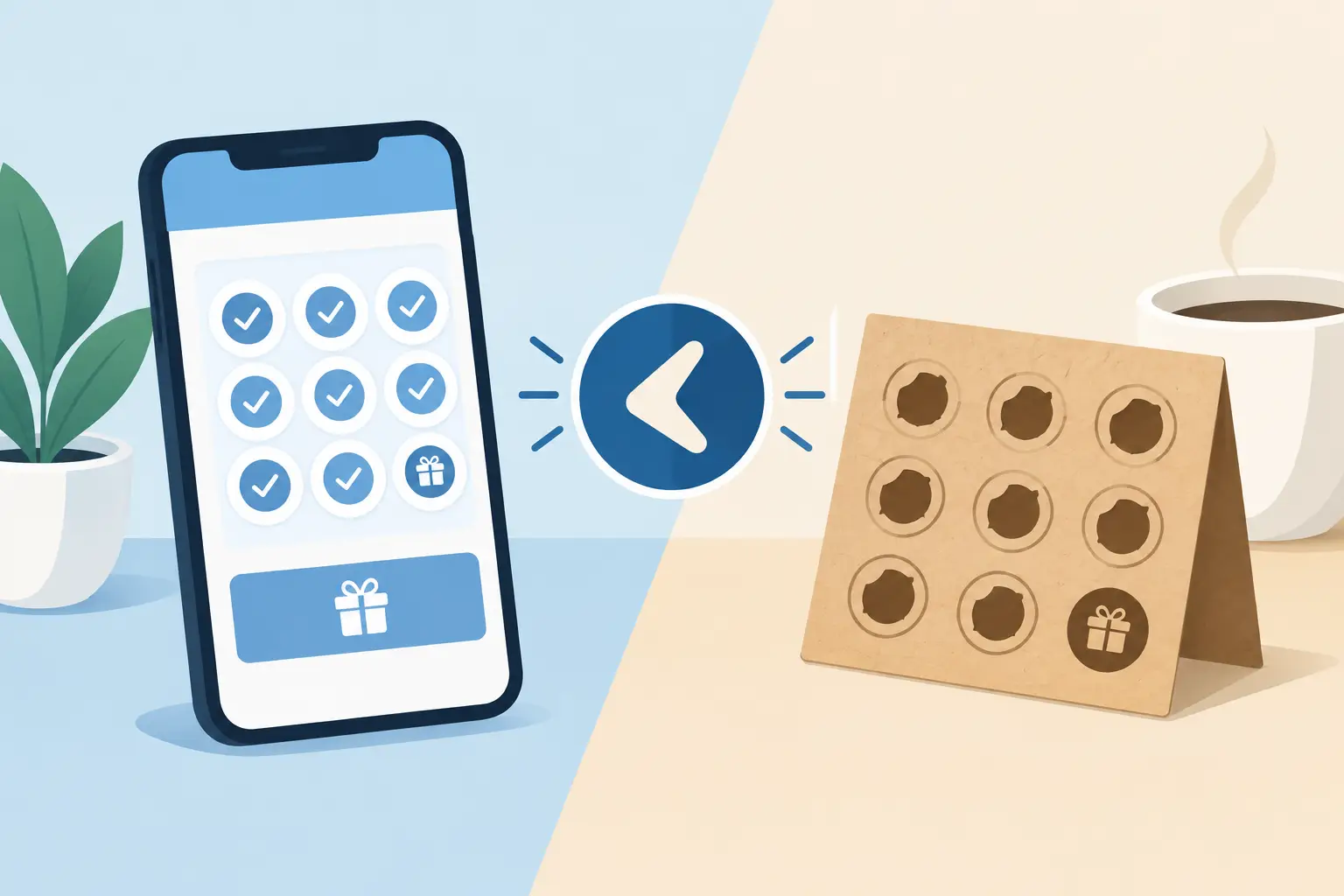
A customer hands over a worn paper card with eight of 10 stamps, and the employee cannot tell whether it is genuine, duplicated, or from another location. The free item may still be worth honoring, but that small moment shows why loyalty programs can create more operational work than expected. Digital punch cards vs. paper punch cards: is switching to BoomerangMe worth it? The answer depends less on novelty and more on whether a business needs better visibility, consistency, and control over a program it already knows customers use.
For many small and mid-sized businesses, paper cards remain familiar, inexpensive, and easy to explain. A digital program can improve the customer experience and reduce manual effort, but it also introduces a platform that must be configured, communicated, and maintained. The right decision is based on the operating reality of the business, not the assumption that digital is automatically better.
What paper punch cards still do well
Paper punch cards have endured for good reasons. They are straightforward: print the cards, define the reward, train employees to stamp them, and hand them to customers. No app download, customer profile, or technical setup is required. For a single-location business with a simple offer and a mostly walk-in customer base, that simplicity can be valuable.
They also create a physical reminder. A card in a wallet or on a refrigerator can prompt a return visit in a way a forgotten email may not. Businesses that have low transaction volume, limited staff capacity, or customers who prefer minimal technology may find that paper remains an appropriate fit.
The trade-off is that paper provides little operational insight. A business usually cannot see how many cards are active, how frequently customers are returning, which offers perform best, or whether loyalty activity differs by location. Lost cards, inconsistent stamping, employee errors, and unauthorized reproductions are also difficult to manage. These issues may be minor at first, but they become more noticeable as transaction volume and the number of locations increase.
What changes with digital punch cards
A digital punch card moves the loyalty record from a physical card to a customer-facing digital pass or account. Instead of carrying a stamped card, the customer collects visits or purchases electronically and receives a reward when the defined threshold is reached.
The practical benefit is not merely that the program looks more modern. Digital loyalty gives the business a more consistent system for issuing rewards and managing program rules. Staff can follow a defined process rather than relying on a stamp, marker, or stack of printed cards. Customers are less likely to lose their progress, and managers have a clearer view of whether the program is being used.
A platform such as BoomerangMe can be a fit for businesses that want to create digital loyalty cards and manage customer engagement without building their own application. It may support a more organized program, particularly for businesses that want branded digital passes and a better way to communicate offers or updates to enrolled customers.
That said, software does not fix an unclear loyalty strategy. If the reward is unappealing, employees do not mention the program, or customers do not understand how to join, a digital card will not create repeat business by itself. The platform needs to support a program with a sensible offer, a simple enrollment process, and a staff workflow that holds up during busy periods.
Digital punch cards vs. paper punch cards: compare the operating impact
The decision becomes clearer when it is evaluated across the daily work required to run the program.
Customer adoption and convenience
Paper cards have almost no barrier to entry. A customer accepts one at the counter and is immediately enrolled. Digital cards can require a phone number, QR code scan, text message, or another enrollment action. That extra step can reduce participation if it is poorly explained or takes too long.
However, paper also puts the burden of retention on the customer. If the card is lost, the customer often loses their progress. Digital programs can make the record easier to retain and access, which can be more convenient for regular customers. The best approach is to make enrollment fast and give staff a short, consistent script for explaining the value.
Employee workflow
A paper card is simple until exceptions arise. Staff may need to decide what to do when a card is damaged, forgotten, partially stamped, or disputed. Managers also have limited ability to verify how rewards were issued.
Digital systems can create more consistency, but only after proper setup and training. Employees need to know how customers enroll, how a visit or purchase is credited, how rewards are redeemed, and what to do when a customer cannot access their pass. A rushed launch can replace paper-card confusion with technology-related confusion. Clear configuration, a quick reference process, and ongoing support matter as much as the software itself.
Reporting and decision-making
This is often the strongest reason to move beyond paper. With physical cards, the business may know that customers like the program, but it cannot easily measure participation or outcomes. Managers are left to estimate how many repeat visits the program creates and how much the reward costs.
Digital loyalty can provide data that supports more informed decisions. Depending on the platform configuration, a business may be able to monitor enrollment, redemptions, visit patterns, and campaign activity. That information can help a manager adjust the reward threshold, identify an underperforming location, or determine whether a promotion is worth repeating.
Data is useful only when someone owns it. A business should decide who will review program performance, how often results will be checked, and what decisions the team expects the information to support.
Cost and administration
Paper cards appear inexpensive because the unit cost is low. But printing, reordering, replacement cards, staff time, and untracked reward redemptions all have a cost. These costs can be manageable for a small program, yet they are rarely measured precisely.
Digital punch cards typically involve subscription costs and initial implementation time. Businesses should account for platform fees, setup, branding, staff training, customer communications, and ongoing administration. The question is not whether digital costs more than printing cards. It is whether the added control, visibility, and customer retention potential justify the recurring investment.
For a business with a small, stable customer base and one simple offer, paper may remain the more economical choice. For a growing business that wants better reporting, consistent multi-location execution, or a more durable customer record, digital can become the more practical long-term option.
When switching to BoomerangMe is likely worth it
Switching is most likely to make sense when the current paper program is creating friction or limiting growth. Common indicators include frequent lost cards, inconsistent reward handling, multiple locations using different processes, or no reliable way to see whether the program drives repeat visits.
BoomerangMe may also be worth considering when a business wants its loyalty program to become part of a broader customer engagement process rather than a counter-only promotion. A digital pass can give the program a more consistent brand presence and provide a foundation for targeted customer communications, provided the business has appropriate customer permissions and a clear communication plan.
It may be less compelling when the business has very limited customer volume, no one available to administer the program, or a customer base that strongly resists digital enrollment. In those cases, improving the paper program first may be the sensible move. Standardize the reward rules, track card distribution and redemptions manually for a period, and identify whether the real issue is the medium or the program design.
Plan the switch as an implementation, not a purchase
A loyalty platform should be introduced with the same care as other operational software. Before launch, define the reward rules, identify the customer enrollment path, decide how staff will credit activity, and establish a process for customer support. Test the workflow at the point of sale before announcing it broadly.
It is also wise to decide what happens to existing paper cards. Some businesses honor them through a transition period, while others convert qualifying customers to the digital program. The goal is to avoid making loyal customers feel that the rules changed against them.
A trusted implementation partner can help reduce the burden of platform setup, staff onboarding, and ongoing maintenance. That is especially useful when internal teams already have full operational responsibilities and cannot spend weeks troubleshooting a new customer-facing process.
The best loyalty program is the one employees can run consistently and customers can understand in seconds. If BoomerangMe helps create that consistency while giving the business information it will actually use, switching can be worthwhile. If paper cards already work without creating meaningful friction, there is no need to replace a simple process merely to make it digital.