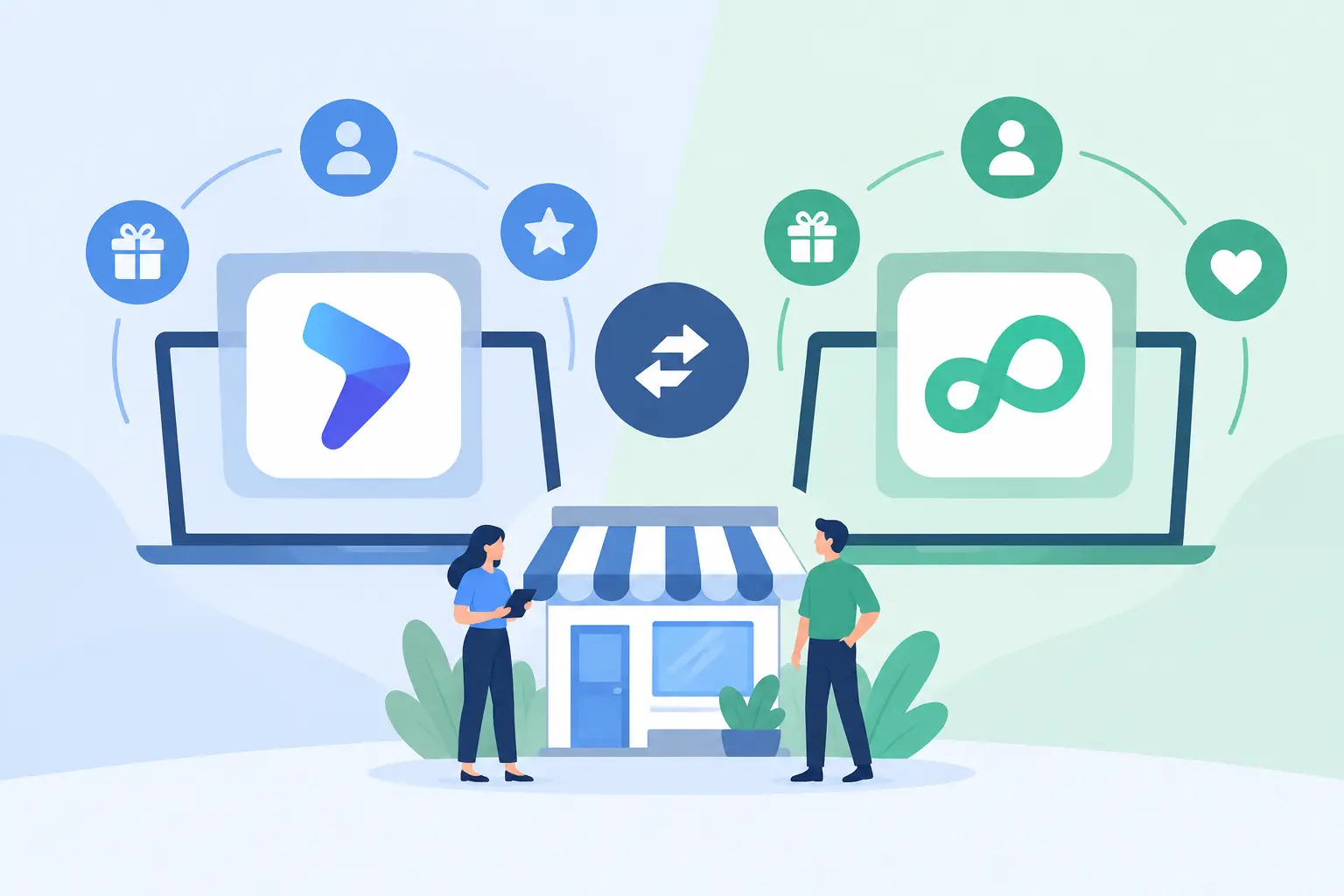
A loyalty program can look simple from the customer side: scan a code, collect a reward, come back again. Behind that experience, however, are decisions about offer design, staff workflow, customer data, wallet passes, branding, and ongoing management. The question, “BoomerangMe vs. Loopy Loyalty: which fits your small business?” is less about finding a feature list winner and more about choosing a program your team can run consistently.
Both platforms support digital loyalty programs built around mobile wallet experiences. Both can help replace paper punch cards and make rewards easier to carry, find, and use. The better fit depends on how much flexibility you need, the type of loyalty model you want to operate, and whether your business has the time and support needed to configure the program well.
BoomerangMe vs. Loopy Loyalty: the core difference
At a practical level, Loopy Loyalty is often a straightforward choice for businesses that want to launch a digital stamp-card or points-based program without turning loyalty into a major technology project. A coffee shop, salon, car wash, fitness studio, or local retailer may simply need a clear offer: buy a set number of items or visits, then receive a reward. That simplicity can be a strength when staff adoption and customer participation are the main priorities.
BoomerangMe generally offers a broader loyalty and digital wallet marketing toolkit. It may fit businesses that want more room to customize passes, campaigns, customer communications, reward structures, or branded experiences. It can also be relevant for agencies, consultants, franchises, and businesses operating programs for multiple locations or clients.
That does not make one platform universally better. More flexibility can create more configuration work. A smaller, more focused program can be easier to explain, train, and maintain. The right decision starts with the operating model behind your loyalty initiative.
Start with the loyalty program you can sustain
Many small businesses choose software based on features they may use later. A better starting point is to define the one customer behavior you want to encourage now. For a café, that may be repeat weekday purchases. For a service business, it could be a return visit or a referral. For a retailer, it may be increasing purchase frequency or rewarding higher-value customers.
If your program is a familiar digital version of “buy nine, get one free,” Loopy Loyalty may provide the direct path you need. The offer is easy for customers to understand and easy for employees to support at the counter. A program with fewer rules also reduces disputes around whether a purchase qualified or when a reward can be redeemed.
If your business needs several pass types, more tailored customer journeys, or a program that extends beyond a basic stamp card, BoomerangMe may be the stronger candidate. The additional capacity is valuable only when it supports a defined business process. Adding tiers, promotions, notifications, and multiple reward paths without a clear plan can make the experience harder for both employees and customers.
Before selecting either platform, write the program in plain language. State how a customer joins, what action earns credit, how the reward is redeemed, and who can resolve an issue. If the program cannot be explained in a few sentences, it may not be ready to configure.
Customer experience and mobile wallet adoption
Both options center on a mobile-first loyalty experience, commonly using passes that customers can keep in Apple Wallet or Google Wallet. This avoids requiring customers to download and remember another standalone app. For local businesses, that lower barrier can matter more than an extensive set of advanced features.
The real customer experience begins before a pass reaches a phone. Consider how customers will enroll: at checkout, through a QR code, from a receipt, during an online purchase, or through a staff invitation. Then consider what happens when they return. Can the employee identify the pass quickly? Is the scanning or validation process consistent? Does the customer receive a clear indication of progress toward a reward?
Loopy Loyalty can be attractive when the goal is a clean, recognizable card experience with limited friction. BoomerangMe can be attractive when branded pass design and broader campaign options are central to the experience. In either case, the pass should make the reward and next action immediately clear. A crowded design or vague promotion is unlikely to drive repeat visits.
Branding deserves attention, but it should not overshadow usability. Use a recognizable logo, readable colors, and concise offer language. Test the pass on actual devices used by your customers and staff rather than relying only on desktop previews.
Administration, staff training, and support needs
A loyalty platform is not fully implemented when the account is created. It is implemented when staff can enroll customers, issue credits, redeem rewards, and handle exceptions without guessing. This is where small businesses often lose value from otherwise capable software.
Loopy Loyalty may require less administrative overhead for a business with one simple program and a small team. That can be especially useful when an owner or manager is responsible for marketing, operations, and daily customer service. The trade-off is that a focused platform may not accommodate every future campaign idea or complex operating requirement.
BoomerangMe may require more upfront planning because greater customization creates more decisions. You may need to establish naming conventions, pass templates, reward rules, staff permissions, campaign processes, and procedures for multiple locations. Those steps are worthwhile for a business with a larger or more varied loyalty strategy, but they should be owned by a specific person or implementation partner.
For either solution, staff training should cover the customer-facing workflow and the edge cases. Employees need to know what to do when a phone is unavailable, a scan fails, a customer believes a reward is missing, or a promotion has expired. A one-page counter guide can prevent inconsistent handling and protect customer trust.
Data, integrations, and operational fit
Do not assume a loyalty tool will automatically connect to every point-of-sale system, ecommerce platform, CRM, or marketing system your business uses. Integration capabilities can vary by product, plan, configuration, and vendor updates. Confirm the current requirements before making a purchase decision.
If loyalty activity needs to inform marketing campaigns or customer reporting, identify exactly what data must move between systems. For example, you may need customer enrollment details, visit counts, purchase events, reward redemptions, or consent status. Then determine whether the process will be automated, exported on a schedule, or managed manually.
A manual process is not inherently a problem for a single-location business with modest volume. It becomes a problem when it is undocumented, assigned to no one, or depends on one employee remembering extra steps during a busy shift. The same principle applies to notifications and promotions. A monthly offer that is sent reliably is usually more valuable than an ambitious campaign calendar that is never maintained.
Businesses with multiple locations should also establish who owns the program. Centralized control can preserve consistent branding and reward rules, while location managers need enough access to support customers locally. This is an area where implementation planning matters as much as software capability.
A practical decision framework
Choose Loopy Loyalty when your priority is a simple digital loyalty experience, a straightforward reward structure, and a launch process that your team can manage with minimal ongoing administration. It is often a sensible fit when speed, clarity, and consistent counter-level execution matter most.
Choose BoomerangMe when your business needs a more adaptable digital pass and loyalty environment, expects to run varied campaigns, or wants room to support multiple use cases, locations, or client programs. It is better suited to organizations prepared to define and maintain a more detailed configuration.
In both cases, review the current pricing, plan limits, supported wallet options, available integrations, branding controls, and support terms against your own requirements. A short vendor demonstration using your actual loyalty scenario can reveal more than a broad feature comparison. Ask the provider to show enrollment, reward issuance, redemption, reporting, and the administrative steps required to change an offer.
The strongest loyalty program is not the one with the longest feature list. It is the one your customers understand, your employees can operate confidently, and your business can maintain after the initial launch. Treat the selection as an operational decision, then give implementation the same attention you would give the offer itself.