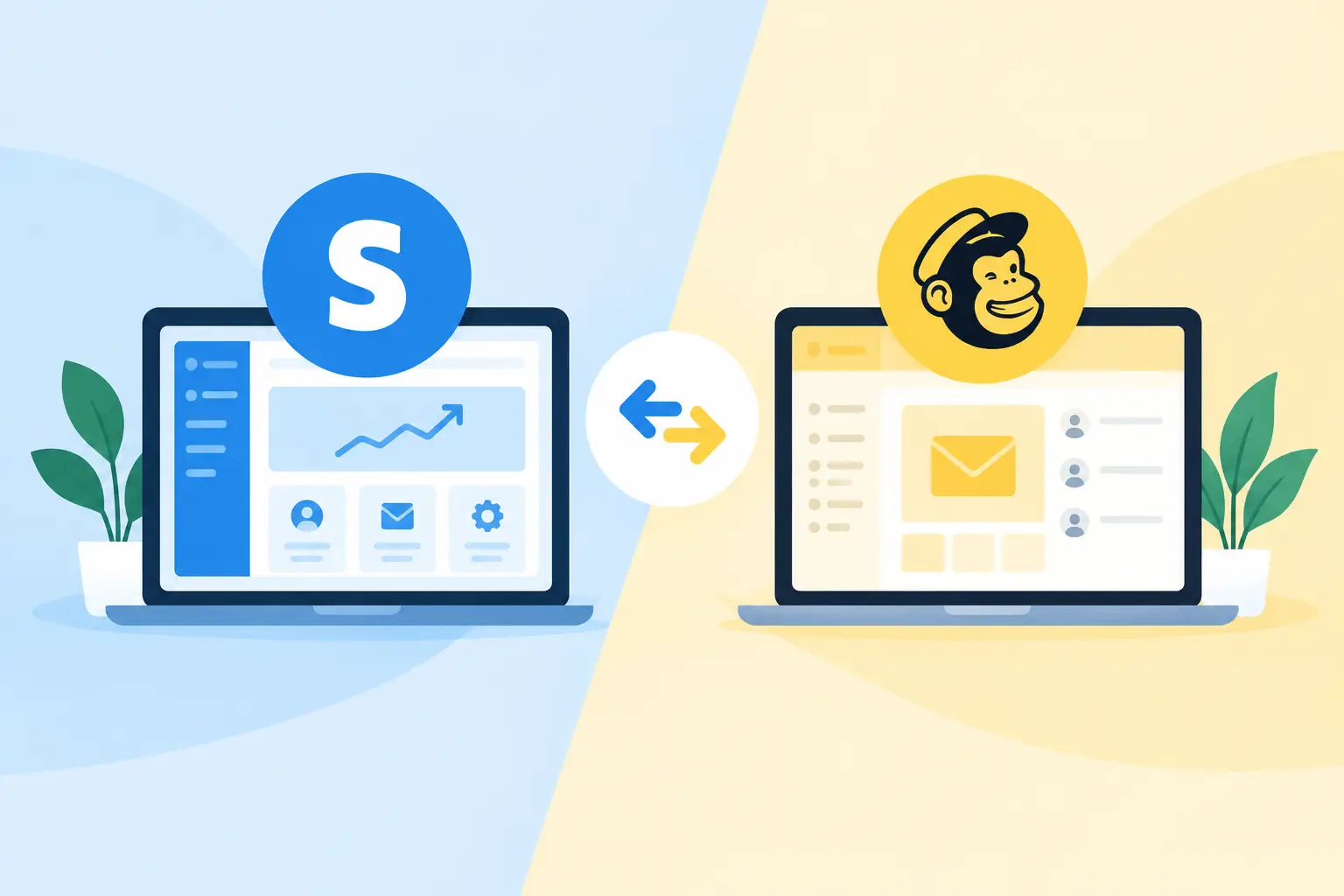
A growing business can outgrow an email tool in two very different ways. It may need better campaign management, audience targeting, and reporting. Or it may need email to work as part of a broader path that captures leads, sells an offer, and follows up automatically. The question, “Systeme.io vs. Mailchimp: which fits your email marketing and sales needs?” comes down to which of those operational gaps you need to solve.
Mailchimp is primarily an email marketing platform with an established position in small-business marketing. Systeme.io is designed as a more consolidated sales and marketing platform, combining email with landing pages, funnels, checkout capabilities, courses, and automation. Neither is automatically the better product. The practical choice depends on your sales model, existing software, internal ownership, and willingness to manage a more connected marketing system.
Systeme.io vs. Mailchimp for email marketing and sales
Mailchimp is often the clearer fit when email marketing is the central requirement. A business may already have a website, ecommerce platform, CRM, scheduling application, and payment process in place. In that environment, the goal is usually to build a clean subscriber database, create campaigns, segment audiences, automate follow-up messages, and understand engagement. Mailchimp supports that focused use case without requiring the team to move its broader customer journey into a new platform.
Systeme.io takes a different approach. It is intended for businesses that want one environment for capturing prospects and moving them toward a purchase or enrollment. Instead of connecting separate tools for a landing page, email sequence, sales page, checkout, and digital delivery, teams can build much of that workflow within Systeme.io.
That consolidation can reduce software sprawl. It can also shift more responsibility into one platform. A team needs to decide who will own page updates, automation logic, contact hygiene, testing, and ongoing campaign maintenance. Buying an all-in-one platform does not eliminate those tasks. It changes where they are performed.
Where Mailchimp is the stronger fit
Mailchimp is well suited to organizations that view email as a marketing and customer communications channel rather than the center of a complete online sales operation. It is commonly useful for local service businesses, retailers, nonprofits, professional firms, and organizations with established web and commerce systems.
Its strength is familiarity. Many employees, contractors, and agencies have worked with Mailchimp before, which can shorten training time. Its templates, campaign tools, audience management, and performance reporting make it practical for recurring newsletters, promotions, event notices, re-engagement campaigns, and basic automated email journeys.
Mailchimp can also be the less disruptive choice when your business already relies on specialized systems. For example, an ecommerce company may prefer to retain its store platform as the source of product and order data. A professional services firm may want its CRM to remain the system of record for opportunities and client activity. In those cases, adding or improving an email marketing layer may be more sensible than rebuilding the customer journey around an all-in-one platform.
The trade-off is that the experience can become fragmented. Leads might enter through one application, receive email from another, book through a third, and pay through a fourth. Each connection should be tested and monitored. If the integration breaks, campaign reporting may no longer reflect the full path from first touch to sale.
Mailchimp considerations for operational teams
Mailchimp still needs governance. Someone should define who can import contacts, what consent standards apply, how audiences are structured, and when inactive or duplicate records are cleaned up. Email performance depends heavily on list quality and message relevance, not simply on how attractive a template looks.
Teams should also confirm that required integrations, automation triggers, user permissions, and reporting fields work before committing to a rollout. This is particularly important if multiple departments send communications from the same account.
Where Systeme.io is the stronger fit
Systeme.io is most compelling for businesses that sell directly through digital campaigns and want fewer handoffs between marketing steps. A consultant selling a program, a training provider offering paid courses, a coach running webinars, or a small business with a focused digital offer may benefit from keeping lead capture, nurturing, checkout, and access delivery in one place.
A typical workflow might begin with a landing page offering a guide or registration. The new contact enters an email sequence, receives follow-up messages based on a defined action, reaches a sales page, and completes a purchase. The business can then deliver a course or membership access through the same system. For a lean team, that can be easier to manage than coordinating multiple vendors.
The advantage is not merely convenience. A connected workflow can make it easier to see where a prospect stops progressing. If a campaign attracts sign-ups but few purchases, the team can review the email sequence, offer, sales page, or checkout experience without pulling data from several systems.
However, Systeme.io is not necessarily the right answer for a business with complex operations. Organizations with advanced CRM requirements, large product catalogs, sophisticated customer service processes, specialized analytics needs, or deeply embedded business systems may find that a purpose-built stack remains more appropriate. Consolidation is valuable only when the platform supports the processes that matter most.
Systeme.io considerations for implementation
A successful setup requires more than creating a funnel template. Teams should map the intended customer journey before building: where leads come from, which communications they receive, what counts as a conversion, how payment and fulfillment work, and who responds when a customer has a problem.
It is also wise to establish naming standards for campaigns, tags, pages, and automation rules. Without them, an account can become difficult to maintain as offers and campaigns multiply. Test every form, email trigger, purchase confirmation, access rule, and internal notification using realistic scenarios before going live.
Comparing the practical trade-offs
Mailchimp generally favors flexibility within an existing technology environment. Systeme.io generally favors consolidation for a defined online sales journey. That distinction matters more than any individual feature list.
Choose Mailchimp when your business needs capable email marketing, when other systems already handle the website and sales process well, or when you need to coordinate email with an established CRM or ecommerce operation. It can be a sensible choice for teams that want email ownership without redesigning their customer acquisition process.
Choose Systeme.io when email campaigns are directly tied to landing pages, sales offers, payment collection, and digital delivery. It is especially practical when a small team wants to reduce the number of tools it must configure and support.
Pricing should be evaluated beyond the entry-level subscription. Consider the total operating cost: paid plan limits, contact growth, transaction-related needs, connected applications, staff training, implementation time, and ongoing administration. A lower monthly platform fee can become expensive if it creates manual work or requires additional tools. Conversely, a more comprehensive platform may cost more than necessary if your team uses only its email function.
Make the decision around ownership, not features
Before selecting either platform, identify the person or team responsible for the system after launch. They should be able to manage user access, maintain contact data, review automations, respond to deliverability issues, update campaign assets, and document key workflows. Marketing software is an operational system once it begins handling customer communications and revenue activity.
Ask a few direct questions during evaluation. Does the platform fit the way customers currently buy from you? Which systems must exchange data with it? Can your staff support the workflow six months from now? What happens when an employee leaves or a campaign needs an urgent update? These questions expose implementation requirements that feature comparisons often miss.
For businesses that need help turning a platform decision into a working process, MBH Web Services can support the practical work around adoption, including setup, configuration, user onboarding, and continuing maintenance. The goal is not simply to activate an account. It is to establish a system your team can operate with confidence.
The better platform is the one your organization can maintain while giving customers a consistent experience. Start with the customer journey and the team that will run it, then select the software that makes those responsibilities clearer rather than more complicated.