What does the 5.3x loyalty ROI benchmark really mean?
A loyalty program can bring in repeat business. But it also costs time and money to set up, promote, and maintain. The useful question isn’t just how many customers sign up. It’s whether the additional profit is worth what you put in.
The Antavo Global Customer Loyalty Report 2026 offers one point of comparison. It found that 92.7% of loyalty program owners who reported on performance said their programs delivered positive ROI. Among those reporting positive returns, average ROI was 5.3x.
That figure is a benchmark, not a forecast for your business. It’s based on reported outcomes, and it does not mean every program earns that return. Results depend on factors like customer visit frequency, reward costs, staff adoption, and whether you can connect loyalty activity to actual sales.
For a small business, the practical takeaway is encouraging but grounded: loyalty can pay off when the program gives customers a clear reason to return and makes it easy for your team to deliver the experience consistently.
Define ROI before you choose a reward
It’s easy to count members, stamps, or reward redemptions. Those numbers tell you whether people are using the program. They don’t tell you whether it’s making the business more profitable.
Start by agreeing on what a successful program should change. For example:
- Bring occasional customers back more often.
- Encourage a second visit within a set period.
- Increase average check size without giving away too much margin.
- Reduce the number of manual follow-up tasks for staff.
Then decide how you’ll calculate the result. One straightforward approach is to compare the added gross profit you can reasonably attribute to the program against the full cost of running it. Include software, setup, discounts or rewards, and the time your team spends managing the program. Track revenue too, but don’t treat revenue as profit: reward costs and product margins matter.
Choose a baseline before launch. Compare performance with a similar period, customer group, or location. Note any other changes, such as a seasonal promotion or new menu, that could also affect sales. This won’t make the comparison perfect, but it helps you avoid giving the loyalty program credit for changes it didn’t cause.
Design a reward customers can reach
A reward needs to feel worthwhile to a customer and make sense for your margins. It also needs to be close enough to feel achievable.
A FaveCard 2026 study of 1,013 small businesses found that loyalty cards with a reward reachable in two to four weeks had an observed completion rate of about 11.4%. Cards with a four-to-eight-week reward window had a rate of about 9.3%. For a 16-to-32-week window, the rate was about 1.2%.
These figures describe one dataset, not a guaranteed outcome for every business. They do, however, point to a useful design question: how long does it take a typical customer to earn a reward? If it takes too long, people may lose interest before they get there.
A practical way to start:
- Estimate normal visit frequency. How often do your regulars usually come in?
- Set a first reward that feels attainable. Avoid making customers wait so long that the program fades from memory.
- Check the cost. Choose a reward that is appealing but doesn’t erase the margin you hope to earn.
- Review the data. If few customers reach the reward, revisit the number of visits, time window, or reward itself.
For businesses with different customer types or purchase patterns, a single reward structure may not fit everyone. Start with the simplest approach you can manage, then make changes based on what customers actually do.
Make participation easy for customers and staff
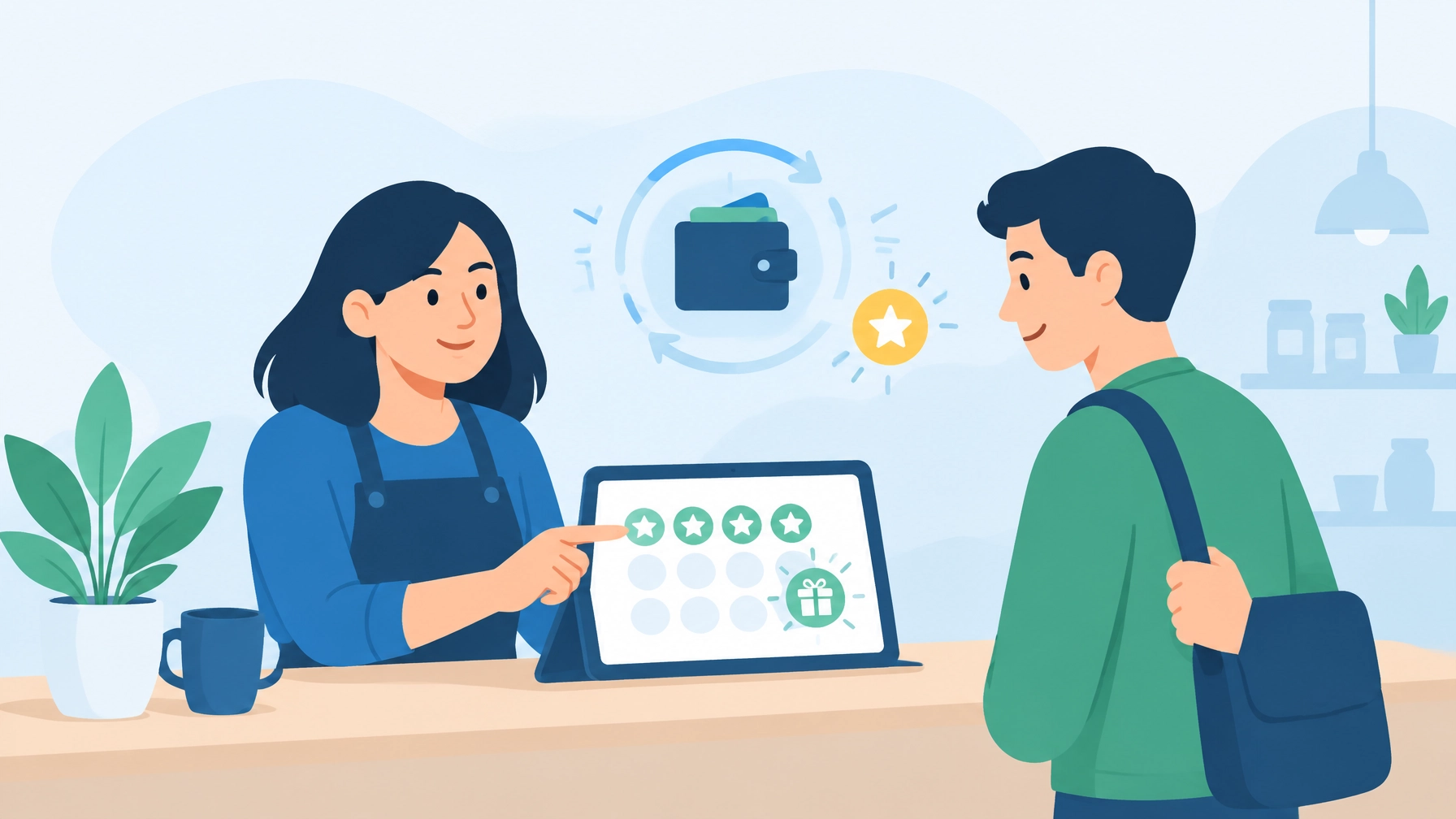
A program only has a chance to influence repeat visits if customers can join and staff can explain it quickly. Paper cards can work, but they can be misplaced and offer little help with follow-up. A digital option can keep the card close at hand and connect rewards with customer communication.
BoomerangMe is an AI-powered customer loyalty platform that supports digital stamp and punch cards stored in Apple Wallet and Google Wallet. It also offers automated push notifications, SMS and email, geo-fenced messaging, CRM segmentation, POS/CRM integrations, and automated ROI reports.
The goal is not to use every feature at once. It’s to reduce friction where it matters. A digital card can make the reward easy to find. A POS integration can help staff record progress without adding extra steps. A timely message can remind a customer about an offer or reward, while segmentation can help you avoid sending the same message to everyone.
Before launch, walk through the customer experience from enrollment to redemption. Ask a staff member to explain the program in one sentence, then test the steps at checkout. If the process is confusing or slows down service, simplify it before inviting customers to join.
Measure behavior that can lead to a return
A useful loyalty dashboard should help you answer a few straightforward questions:
- Are customers joining?
- Are they returning and earning rewards?
- Are they redeeming rewards?
- Do participating customers spend or visit differently from a relevant comparison group?
- What did the program cost, including rewards and operating time?
BoomerangMe offers automated ROI reports, but software can only report on the data and setup behind it. Your POS or CRM connection, program rules, and comparison method all affect what you can learn. Confirm what your integrations capture and how the reports define their metrics before treating a result as proof of profit.
Keep the first review simple. Look at enrollment and reward completion first, then compare repeat visits or spending where your data allows. If results are unclear, check whether staff are consistently enrolling customers and recording transactions. A program that isn’t being used consistently can’t produce a meaningful read on performance.
Treat reported results as context, not a promise
Some reported outcomes give businesses a sense of what may be possible. BoomerangMe reports results of up to 2x increases in customer retention rates and an average check size increase of up to 30%. These are reported results, not guarantees; outcomes will vary by business and campaign.
A reported DimCoffee case study describes 3.6x revenue growth and $1.8 million in new sales across 42 locations over eight months. That is a specific multi-location example, not a typical result that a small business should assume it will reproduce.
Use benchmarks to ask better questions, not to make a forecast. What would a modest improvement in repeat visits mean for your business? How much margin would a reward consume? Can your team run the program without adding more busywork? Those answers will be more useful than a headline number on its own.
Start small, then improve what the data shows
A high-ROI program doesn’t need to begin with complicated rules or a flood of messages. Start with one clear goal, an attainable reward, and a reliable way to record participation. Give staff a simple explanation and review the results on a regular schedule.
If customers aren’t completing the reward, consider shortening the path. If they complete it but don’t return, reconsider whether the reward encourages the next visit you want. If the program creates too much manual work, look at where the POS or CRM process can be simplified.
This is where choosing and setting up business loyalty software carefully matters. The right tool should fit your workflow, connect to the systems you already use where possible, and give your team a manageable way to act on the information.
Build a program your team can actually run
At MBH Web Services, we help small businesses choose and implement software around their real processes. For loyalty programs, that can include evaluating tools, configuring the reward journey, connecting POS and CRM systems, and training your staff to use the setup with confidence.
We work with small and medium businesses, including professional service providers, B2B firms, and e-commerce brands. Deployments typically take about five days, depending on the systems and scope involved. The aim is a custom configuration, not a generic template, and a program that fits into everyday work.
If you’re considering BoomerangMe, we can help you assess whether it fits your needs and set up a campaign with practical measurement in mind. Talk with MBH Web Services for a low-pressure conversation about your goals, current tools, and next steps.